Human interface
Sight, sound, voice, touch, and spatial perception are the center of the map.


Talking Computers map
An exploratory map for thinking about AI workflows: start with a human task, consider the inputs and tools it needs, and choose an output you can evaluate. The examples are possibilities to investigate with the appropriate tools.
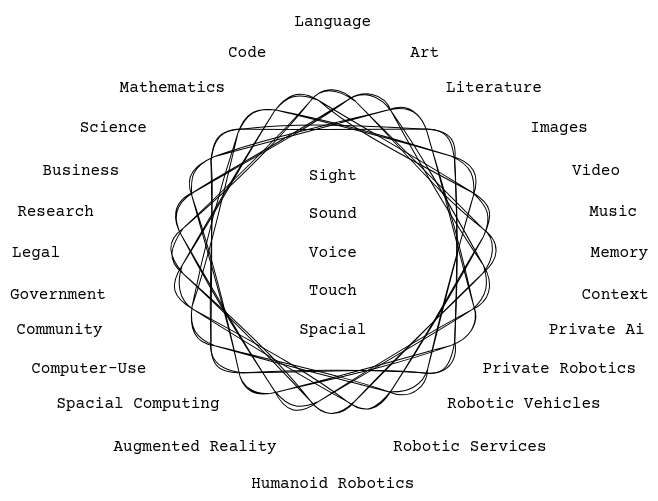
Sight, sound, voice, touch, and spatial perception are the center of the map.
Conversation gives intent a portable control layer across tools, media, memory, and action.
Documents, code, images, video, music, research, law, business, science, government, and community work can connect.
Files, accounts, permissions, backups, review, retention, private AI, and lifecycle practices keep the system trustworthy.
Examples
Voice → transcript → task list → CRM update
Device photo → observations → repair checklist
Document → summary → risks → decision memo
Sketch → interface → code → prototype
Meeting → memory → follow-up → workflow
Room → spatial map → AR instruction → robotic action
When AI mediates files, memory, workflows, business, legal questions, and devices, privacy, ownership, permissioning, and local context become central design concerns.
Organized context, assembled tools, and kept data make AI workflows inspectable instead of disposable conversations scattered across accounts.
The human supplies intent, taste, ethics, embodied experience, social understanding, priority, and final responsibility.
Next step
Start with the framework, then decide which information, tools, privacy boundaries, and workflows need to be made legible.